



Introduction
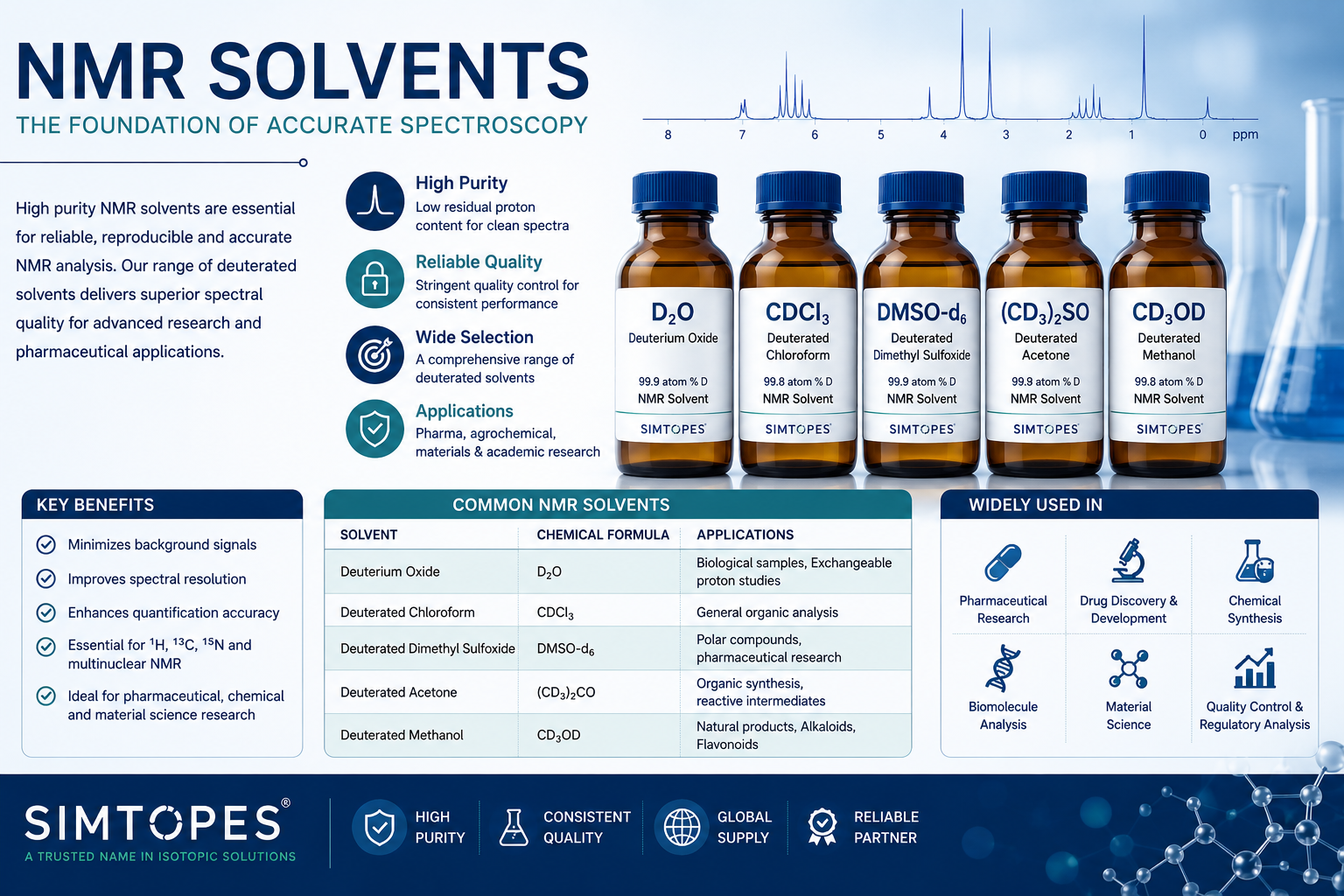
Nuclear Magnetic Resonance (NMR) spectroscopy is one of the most powerful analytical techniques used in pharmaceutical research, chemical synthesis, material science, and academic laboratories. The accuracy and reliability of NMR results largely depend on the quality and selection of the solvent used during analysis. This is where NMR solvents, particularly deuterated solvents, play a critical role.
At Simtopes, we provide high-purity NMR solvents designed to support precise and reproducible analytical results for researchers and laboratories worldwide.
Why Deuterated Solvents Are Important
Deuterated solvents offer several advantages:
Reduced Background Signals
The replacement of hydrogen with deuterium minimizes unwanted solvent peaks in the NMR spectrum, allowing clearer observation of sample signals.
Instrument Locking
Modern NMR instruments use deuterium signals to maintain magnetic field stability during data acquisition, improving spectral accuracy.
Enhanced Data Quality
Deuterated solvents provide better resolution, improved signal-to-noise ratios, and more reliable analytical results.
Broad Compatibility
Different deuterated solvents are available to dissolve a wide range of organic, inorganic, and pharmaceutical compounds.
Commonly Used NMR Solvents
Deuterated Chloroform (CDCl₃)
One of the most widely used NMR solvents for organic compounds due to its excellent solvating properties and relatively simple spectrum.
Deuterated Dimethyl Sulfoxide (DMSO-d₆)
Ideal for polar compounds, pharmaceuticals, peptides, and molecules with limited solubility in non-polar solvents.
Deuterium Oxide (D₂O)
Commonly used for water-soluble compounds, biological samples, and biomolecular studies.
Deuterated Methanol (CD₃OD)
Suitable for polar organic compounds and pharmaceutical research applications.
Deuterated Acetone ((CD₃)₂CO
Frequently used for compounds requiring moderate polarity solvents.
Deuterated Acetonitrile (CD₃CN)
Popular in analytical chemistry and pharmaceutical research due to its favorable solvent properties.